Showing posts with label Fiction. Show all posts

Wednesday, December 17, 2008

When My Name Was Keoko, by Linda Sue Park

WhenMyNameWasKeoko

I really, REALLY liked this book. I know I'm ignorant of Asian history, but until I read this book I didn't realize how much my ignorance mattered.  When My Name Was Keoko showed me that the Japanese occupation of Korea in the first half of the twentieth century was not only an attack on the Korean government and military, but on Korean culture and identity as well.

Sun-Hee is a young girl living with her family in Korea during the Japanese occupation of her country in the years before and during World War II.  For decades, the Korean people were not allowed to be Korean:

"A long time ago, when Abjui was a little boy and Uncle just a baby, the Japanese took over Korea.  That was in 1910.  Korea wasn't it's own country anymore.

"The Japanese made lots of new laws.  One of the laws was that no Korean could be the boss of anything.  Even though Abuji was a great scholar, he was only the vice-principal of my school, not the principal.  The person at the top had to be Japanese.

"All our lessons were in Japanese.  We studied Japanese language, culture, and history.  Schools weren't allowed to teach Korean history or language.  Hardly any books or newspapers were published in Korean.  People weren't even supposed to tell old Korean folk tales.""

Every day is a struggle as the family must balance submission and defiance in order to survive while retaining their identity as Koreans.  New laws are passed requiring all Koreans to adopt Japanese names; Sun-Hee becomes Keoko.  Korean is no longer permitted to be spoken in public.  Symbols of Korean culture and tradition are destroyed.  Koreans must demonstrate complete loyalty to the Japanese Empire and its emperor.  Yet Sun-Hee and her family find ways to hold on to their identity, and to defy the tyranny of their oppressors.

Unfortunately, this is a pattern that has repeated itself countless times throughout human history.  The state defines what a person should think, how a person should be, then methodically eliminates the former ways.  Language, culture, religion, and tradition are deliberately supplanted with a state-defined identity.  Suppression is justified through a pretense of moral superiority, enforced through implication of violence, and legalized through corrupt legislation.  Schools cease to be places of education to become places of indoctrination.  It's happened so often that I must assume it's human nature.

What happened in Korea falls on a spectrum of cultural suppression.  Look on the more extreme end of the spectrum and you'll find ethnic cleansing and genocide.  Look on the less extreme end of the spectrum and you'll find what's happening in the United States today, where public institutions are commandeered to serve as tools of social engineering.  Interpretations of the law are routinely stretched to impose a state-defined sense of morality, to promote a particular way of thinking rather than to protect one's right to believe as one chooses.  Schools have been similarly hijacked.  For example, the primary purpose of history class is no longer to inform students of how our society came to be, but to instill a particular value system in our children's world view.  Even if I agree with the values being taught in the schools - and in general I do - this isn't the school system's right or responsibility.  Far too often, public school attempts to be a secular Sunday School.

I don't think most people recognize the degree to which our government is adopting - and enforcing - social dogma.  And I don't think most people recognize the danger of allowing the state to do so.  This is why the book seemed so relevant to me.  Our country's use of laws and schools to promote a social agenda may be benign when compared to the holocaust, but it is on the same path.  There is such a big gap between modern America and Nazi Germany that you may not see the connection.  See what falls in between and it's easier to see how you could get there from here.  Take a good look at today's society and it may look more like 1930's Korea than you would have guessed.

5 stars 5 out of 5 Stars5 out of 5 Stars5 out of 5 Stars5 out of 5 Stars5 out of 5 stars


Monday, March 03, 2008

The Word and the Void, by Terry Brooks

word_and_void

The Word and the Void is a trilogy consisting of the books Running with the Demon, a Knight of the Word and Angel Fire East.

John Ross has been recruited by the Word to help prevent events that can alter the balance of good and evil.  Every night John Ross dreams of the dark place the world will become if he doesn't do something to prevent it.  In running with Demons, his mission is to keep Nest Freemark, a young girl with magical abilities, from becoming a agent of the Void.  Nest has always known about her magical abilities, but she underestimates the amount of power she has and is totally ignorant of her demon heritage.

In the next book it is actually Nest Freemark that helps John Ross from being deceived into becoming an agent of the Void.  A bad experience has caused him to abandon his work for the word, but Nest manages to lead him back to his work as an agent for good.

Finally in the last book Nest and John work together to help a powerful piece of magic to reach it's potential in becoming a powerful force for good.

I enjoyed each of these books individually and as a series.  I thought they had an interesting take on magic in our modern world.  It also has some insightful ideas on how ignorant people are lead to do such dark things.  The series was pretty dark and I don't know that I'd recommend it as a good read if you are feeling down, but when a sunny day comes along it has a great story and take on the battle of good and evil.

I can honestly say that I read these books solely for the purpose of seeing how Terry links this series with the Shannarah series.  Look for a review soon on that new series including Armageddon's Children and The Elves of Cintra.

Summers at Castle Auburn, by Sharon Shinn

As an illegitimate daughter of a noble, Coriel (Corie) grows up spending just her summers at the Castle Auburn and the rest of the year living as a peasant. This book covers only her summers over the course of her coming of age. She starts out very young and naive. She is infatuated with an arrogant and narcissistic young prince and totally oblivious to the slavery of the Aloria that is happening right under her nose. Corie shares friendships with her half sister Elisandra and the prince's cousin Kent during her summers. Eventually Corie loses her naivety and gains great moral purpose. By the last summer, she makes a decision that will forever exclude her from her posh summer existence. Corie goes back to her peasant life and finds she no longer fits in there either. At this point the happy, but not unexpected ending happens and she lives happily ever after.

One of the things I really liked about this book was that it was told not only using Corie's viewpoint, but in a way that showed her naivety and maturity as the book progressed. For example, in the beginning of the novel, Corie talks about the Aloria as if they are exotic animals, but by the end she recognizes them as an evolved form of humans with thoughts and feelings.

I will admit that while sometimes Corie's ignorance drove me a little crazy, it was nice that she did finally grow up into a moral and respectable young lady. I will admit though that I was unhappy with how the story resolved for Elisandra. (Can't say more about that without spoilers...)

All in all, I'd recommend this novel along with every other Sharon Shinn novel I've read as being worth the read.

Monday, August 06, 2007

The Eye of the World, by Robert Jordan

For slow readers like me, any book over 400 pages takes a real commitment to read. The Eye of the World clocks in at 832 pages. There's nothing wrong with a long book, as long as its pages are filled with a story that holds your interest. The Sharon Shinn series I've been reading recently is a great example of a long story (well over 1,000 pages so far) that leaves you craving more. However, the longer the book, the greater the obligation to make every page count.

Unfortunately, The Eye of the World does not live up to that obligation. It's not a bad story, but it's filled with fluff. The middle portion of the book drags because of this fluff. The cycle of "go to a town, almost get caught, go to the next town" repeats itself a few too many times. This same section of the book also includes pointless scenes, such as the farmgirl that took an interest in Rand despite her mother's and Rand's wish that she would leave him alone. The scene didn't advance the plot, nor did it contribute to character development, so the only reason I can see for its inclusion is to add interest, i.e., keep the reader from getting bored with an otherwise monotonous story.

This book and its sequals are considered one of the top fantasy series out there, and I don't understand why. If I were a faster reader, perhaps the extraneous sections would have added minutes to the reading time instead of hours, and then perhaps the book's flaws wouldn't have been so obvious. My kids often ask me to tell them the stories I've been reading. We all enjoyed the condensed version of the story I shared with them, but the full length version wasn't fun to read.

When I was picking out a book to take on a recent business trip, I found myself in front of the Robert Jordan section. As I held the next book in the series in my hands, it looked and felt like work, not pleasure. Placing the book back on the shelf caused me no heartburn at all. There are too many good fantasy books out there to waste my time on bloat-ware.

Two stars

2 out of 5 Stars2 out of 5 Stars2 out of 5 Stars2 out of 5 Stars2 out of 5 stars

Friday, April 20, 2007

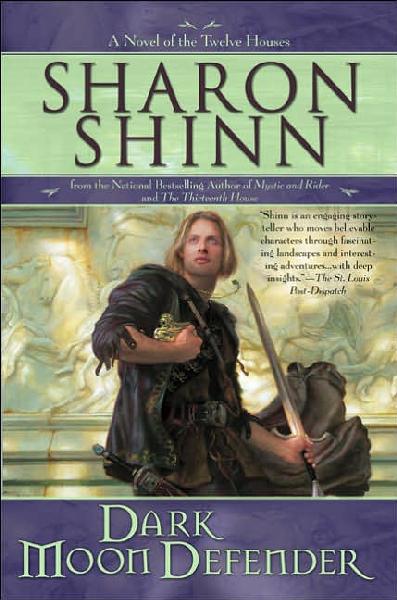
Dark Moon Defender, by Sharon Shinn

Dark Moon Defender is the third book in the Saga of the Twelve Houses. The second book in the Saga, The Thirteenth House, was such a disappointment to me that I've been anxious for the next installment to redeem the series. After months of waiting for the local library system to get the third book, it finally arrived. Like a chug of hearty soup after taking a swig of milk gone bad, the bad taste left by the last book was washed away and replaced with something truly satisfying. In short, I liked it.

Justin has been sent to spy on the Lumanen Convent, the stronghold of a group of religious fanatics bent on overthrowing the government of Gillengaria and eradicating all those endowed with magical abilities, the mystics. While performing his clandestine duties he falls in love with Ellynor, a convent novice who could only love him in return if she abandoned religious and family bonds. The situation is further complicated when Ellynor is exposed as a mystic and must fight for her life.

Once again, Ms. Shinn successfully weaves deeper themes into the story without allowing them to dominate the story. This episode emphasizes the true self, the essence of who we are regardless of our setting or our position in life. Neither Justin nor Ellynor are living as their heart would lead them - Justin is cloaked in his clandestine role, while Ellynor's path in life has been chosen for her. In spite of the apparent incompatibility of their stations, and even though they both know the other is keeping secrets, they come to trust each other. Each senses who the other is at the core. Their confidence in each other's true character is what allows their relationship to blossom and eventually grow into complete devotion.

It's interesting to me that I liked this book so much. It has so many of the same characteristics I didn't appreciate in the previous book. Like episode two, the main story line is an undercover romance between two people that would be wise to avoid a relationship. Not only that, but the one thing that saved the second book is nearly absent in this one, namely the advancement of the overall saga (well, that's not quite true - there are some potentially significant alliances forged between various groups, but you can only guess at the future importance of those alliances). With so much in common with the previous book you might expect a similar reading experience, yet in this case I really liked the result.

I've been reserving five star ratings for the very best books. Maybe I'm being a bit stingy, but I'm giving Dark Moon Defender four stars.


4 Stars
4 out of 5 Stars4 out of 5 Stars4 out of 5 Stars4 out of 5 Stars4 out of 5 stars

Friday, February 16, 2007

The Plot Against America, by Philip Roth

What if America had elected a staunch isolationist as its president in 1940? What if the United States had not come to the defense of England and France in World War II? Just as disturbing a question is what would have happened right here in America if that president had fascist leanings?

Philip Roth provides one possible answer to these questions in his alternative history, The Plot Against America. The isolationist president in Roth's fantasy is Charles Lindbergh. The real-world version of Lindbergh truly was an adamant isolationist, held anti-semitic viewpoints, and may have been a fascist and a Nazi sympathizer. Lindbergh as president opens up some interesting possibilities.

But this isn't just a tale of politics and world events - this is an alternative history of the author himself. The main character is Phil Roth, the author in his pre-teen childhood. Mr. Roth's real-world family and neighborhood are the novel's major players. This approach is the book's primary strength, but also its greatest weakness. Events of global significance ultimately affect real people on a personal level. How better to show this than through the eyes of an impressionable young boy? However, what could have been an intimate portrayal of interrupted youth often turns into an expression of the author's paranoia.

And this leads to what flusters me most about The Plot Against America - I can't tell if the paranoia comes from the author or the characters. Is this a rational man writing about a paranoid father and alternate self, or is this a paranoid man expressing his own biases through his characters? Unable to answer this question, I was also unable to be sure I was getting the message the author intended.

Many events seemed totally implausable to me. I can accept that America could have had its own Krystalnacht if history had unfolded differently. I was expecting the book to include such events before I ever started reading, but the way things happened in the book didn't ring true. Some plot elements were borderline ridiculous. Since I couldn't tell where the author was coming from, I didn't know what to make of these highly unlikely occurrences.

The ending bugs me. First, it's tightly linked to one of those unlikely circumstances. Second, it provides an easy way out of the mess America got itself into. The alternate America strayed from the path we know, and as a result the essence of what America is also should have changed. In Plot, the easy-out ending lets America get right back on track, with the only long-term difference between fantasy and reality being a chapter in the history books.

One of the book's strengths is the way it shows how we are affected by uncertainty, and by our own perception of how others view us.

I've been looking forward to reading this book for a long time. The whole premise really grabbed my attention. Now that I've made it through from cover to cover, I wouldn't say that I'm completely disappointed, but neither did it satisfy my expectations. I'm writing this review a couple of months after I finished the book, and can tell you it didn't stay with me.

3 Stars
3 out of 5 Stars3 out of 5 Stars3 out of 5 Stars3 out of 5 Stars3 out of 5 Stars

Saturday, February 03, 2007

The Grand Sophy, by Georgette Heyer

Sophy Stanton-Lacy, a young unmarried woman, was born in an era of extreme discretion. It is improper for a young lady to allow their affections to show, to ride a large horse, to leave town with a man. This regency woman is very different however from the women of Jane Austin's similarly set novels. She is not concerned with appearances. Her indiscretions range from riding her horse too fast in the park, to standing up to a loan shark armed with a pistol, to running away with the man her cousin has feelings for. All her actions are for good reason though. In the end, everyone ends up married to the right person and no one's reputaion is irreparably damaged.

I enjoyed this novel as well as several other of Georgette Heyer's works. "Devil's Cub" was probably my favorite. All her novels have smart, strong women characters. The men characters are also strong, but usually are won over and somehow made better by the female heroine. I likes the way that the women worked around the restraints of their society to achieve the desired results. Most of the problems in these novels would not exist in today's world, but that is part of what makes them interesting to read.


4 Stars
4 out of 5 Stars4 out of 5 Stars4 out of 5 Stars4 out of 5 Stars4 out of 5 stars

Thursday, December 21, 2006

The Elder Gods, by David & Leigh Eddings

In a land held sacred by the Elder Gods, a bug-like creature called the Vlaugh prepares to take control. The Elder gods are forbidden to kill and have always allowed nature to take its own course, but this time, if they do nothing their sacred land will be overrun. In their desperate attempt to save the land of Dhrall, they wake up the younger gods from their rest, but in a state of infancy resembling mortals. As they wait for the younger gods to grow up, they entice the outlying nations to come to their aid with promises of great riches. The pirate-like people from the land of Maag join along with the Maag's enemies, the Trogite legions, to defeat the Vlaugh.

I thought this book ended really abruptly. It reminded me of a parent that got tired of reading a bedtime story and concluded it by saying... "The bad guy suddenly died of a heart attack and the princess was free." That being said, I really enjoyed the book. The character development made for a great read, despite the weak finish. When the enemy nations came together outside their normal circumstances, they developed many new innovations by working together in friendship. To me, this was a testament to the progress that could be achieved if we banded together in brotherhood instead of hording our technologies.

I have read 3 of the 4 books in The Dreamers series, and so far all of them end in this abrupt way, but as the series progresses, this becomes not only expected, but adds an element of excitement and anticipation for the revelation of why these things happen in future books.

All in all, I'd recomend this as a nice light read in the fantasy genre. A great choice for when you want an adventure without the work of figuring out intricate themes and plotlines.

3 Stars
3 out of 5 Stars3 out of 5 Stars3 out of 5 Stars3 out of 5 Stars3 out of 5 stars

Wednesday, December 20, 2006

The Dark Elf Trilogy, By R.A. Salvatore

The Dark Elf Trilogy is the first three books of Salvatore's Forgotten Realms series. It includes the books Homeland, Exile, and Sojourn. It is in the style of "Dungeons and Dragons," which makes it very familiar as far as the type of abilities, items, and races you might expect to see. Being a huge fan of Fantasy, I really enjoyed this novel. It included everything you would expect from a "Dungeons and Dragons" fantasy book…sword fights, dragons, good and evil, yet it starts in a rather unexpected way.

The main character, Drizzt comes from a rather backwards society. Evil and hatred are the norm in his city of Menzoberranzan. As the third male child of a noble family, his destiny was to be sacrificed upon birth. In the female dominated Dark Elf society, men's lives are of very little worth. A twist of fate changes his course and he is allowed to live.

Drizzt's childhood experiences challenge his thinking. Should he dawn the evil mantle of his society? His father, Zaknafien, teaches Drizzt swordplay and he becomes perhaps the greatest warrior in his city. However, Zaknafien also plants the seeds of doubt in Drizzt's mind about the morality of their culture. As Drizzt struggles with his conscience and the challenges of his society, it comes down to a culminating moment where he must decide between submitting himself to the will of his people or saving a young elf child. He inevitably chooses to save the elf child and his life is turned upside down. He becomes outcast from his people and later hunted. The other races shun and fear him because of the reputation his people have earned. Drizzt's only friend for much of his journeys is Guenhwyvar, a black panther from another plane of existence. Even Guenhwyvar is able to spend little time with Drizzt, needing to return often to its own plane for sustenance. Drizzt struggles to do what he believes to be right while facing searing loneliness and despair.

What I enjoyed most about these books was the look at the great beauty that emerged from such a dark society. It is so easy to blame our actions on our circumstances. Drizzt is a true underdog, yet rose above and allowed his integrity to set his course. Despite the pain it costs him, he never once looks back on his decision with regret... only sorrow. I also enjoyed the amazing picture of the underdark, particularly the city Menzoberranzen. I think perhaps the most beautiful moments in the book were the rare moments when Drizzt felt loved. The only thing I didn’t really like was the overly detailed sword fights. I am not a big fan of strategy and maneuvers so I usually skimmed past these parts, but in spite of that, I found it an excellent book, well worth the read.

4 Stars
4 out of 5 Stars4 out of 5 Stars4 out of 5 Stars4 out of 5 Stars4 out of 5 stars

Thursday, December 14, 2006

So You Want To Be A Wizard, by Diane Duane

I'm waiting for the next book in the Saga of the Twelve Houses to be available at the library. In the meantime I decided to read this.

So You Want to Be a Wizard is the first in the Young Wizards series, which has been called "the first place to go when you run out of Harry Potter." I didn't think it measured up to Harry Potter at all, and I'm not even that big of a Potter fan. Although I don't idolize the almighty Harry, Rowling's books actually have a lot going for them, especially in their use of symbolism and their rich reliance on folklore and traditional beliefs in magic, including a lot of traditions most of us aren't familiar with.

This first Young Wizards book, on the other hand, doesn't have nearly the depth. I thought the book was kind of boring. The characters were flat and the story not interesting enough to hold my attention. In fact it took me a month to finish it, much longer than a 400-page young adult book should take. The last third of the book picks up the pace significantly, introduces some a-little-too-obvious Christian symbolism, and ends up saving the book. I'm still not convinced this is a series I'll want to stick with, but I'm going to give the second book a shot.

I'm giving this book three stars. It sure seem like I've been giving a lot of three star ratings lately. I'm hoping the next book I read will knock my socks off. And it's probably worth pointing out that this book got a lot of five star ratings on Amazon.

3 Stars

3 out of 5 Stars3 out of 5 Stars3 out of 5 Stars3 out of 5 Stars3 out of 5 stars