Monday, March 03, 2008

Leven Thumps and the Gateway to Foo, by Obert Skye

Leven Thumps thinks he is just an underprivileged orphan with no future and no hope. What he doesn't realize is that the magical world of Foo has been waiting for him since before his birth. Leven Thumps was born as the only person with the power to save both the real world and Foo. Leven slowly discovers his magical abilities and the friends that have been waiting to help him until the time he was ready.

I heard someone call this book the Harry Potter for a new generation, but I am not sure I believed it till I read it. While it is not similar in story to Harry Potter, it does have amazing creativity, excitement and adventure. I love that it is unique from many of the stories out there but not at all boring. I don't know that I have read many other books that start so strongly right from the beginning. I like that you don't know what is going on any better then Leven does at the beginning. The reader gets to learn right along with Leven and his friend Winter, what his destiny and powers really are.

I think this is an excellent choice for all ages. The story is simple enough for kids to enjoy, yet in no way boring for someone that needs more complexity in the story. In fact, I'd have to say that Obert Skye left me hungering for more. Thank goodness I waited till there were 3 books out before I discovered it...

The Lightning Thief, by Rick Riordan

The Lightning Thief and other books from the "Percy Jackson and the Olympians" series, brings Greek mythology into the modern world.

Young Percy Jackson has always led a troubled life. With his dyslexia and ADHD he has always managed to get himself into trouble. Finally one day a Fury attempts to assassinate him, and that is when he learns he is a demi god, the son of the Greek god Poseidon. His life from this point forward will never be the same. He goes to a special summer camp run by Dionysus for demi gods where he learns to fight with swords, battle monsters, and read Greek. His adventures then really begin. He fights monsters, travels to Hades, earns favor with some gods, and the anger of others.

I found this book surprisingly thought provoking at times. When Percy and his friend Annabeth (daughter of Athena) were in Hades, they noticed how few people had made it into the "Heaven" portion of Hades and commented on how few people really did good things in their lives. I enjoyed these moments in the book.

As for the story, a lot of it was just rewrites of mythology into modern times. It was actually a fun way to review mythology. I did find the explanation of how mortals have missed the existence of mount Olympus hovering over the empire state building a little weak, but despite that I enjoyed the book.

I think more important then me enjoying the book was the fact that my 9 year old loved it and quickly ready the 3 books that are out in print. She can't wait for the next one to come out.

Summers at Castle Auburn, by Sharon Shinn

As an illegitimate daughter of a noble, Coriel (Corie) grows up spending just her summers at the Castle Auburn and the rest of the year living as a peasant. This book covers only her summers over the course of her coming of age. She starts out very young and naive. She is infatuated with an arrogant and narcissistic young prince and totally oblivious to the slavery of the Aloria that is happening right under her nose. Corie shares friendships with her half sister Elisandra and the prince's cousin Kent during her summers. Eventually Corie loses her naivety and gains great moral purpose. By the last summer, she makes a decision that will forever exclude her from her posh summer existence. Corie goes back to her peasant life and finds she no longer fits in there either. At this point the happy, but not unexpected ending happens and she lives happily ever after.

One of the things I really liked about this book was that it was told not only using Corie's viewpoint, but in a way that showed her naivety and maturity as the book progressed. For example, in the beginning of the novel, Corie talks about the Aloria as if they are exotic animals, but by the end she recognizes them as an evolved form of humans with thoughts and feelings.

I will admit that while sometimes Corie's ignorance drove me a little crazy, it was nice that she did finally grow up into a moral and respectable young lady. I will admit though that I was unhappy with how the story resolved for Elisandra. (Can't say more about that without spoilers...)

All in all, I'd recommend this novel along with every other Sharon Shinn novel I've read as being worth the read.

Saturday, August 18, 2007

A History of Pi, by Petr Beckmann

A History of PI cover

Despite its title, A History of Pi recounts more than the evolution of a geometric constant.  In this case, moving beyond the core topic of the book turns out to be a bad thing.  Yes, there is quite a bit of mathematical history, but the author simply uses that history as a platform to share his extremely biased view of government, religion, and society.  At first it is distracting, then quickly becomes irritating.  If you can make it past the first few chapters, you start to laugh at the off-topic rants.  Once you reach that point, you can brush off the irrelevant bull and pay attention to the math history that motivated you to pick up the book in the first place.
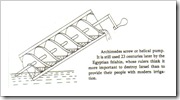
archimedes_screwFor example, a chapter on Archimedes includes a figure with the following caption:

"Archimedes screw or helical pump.  It is still used 23 centuries later by the Egyptian felahim, whose rulers think it more important to destroy Israel than to provide their people with modern irrigation."

Never mind that the chapter never once mentions the helical pump.  Never mind that Egypt's position toward Israel has nothing to do with the history of pi.  The author takes advantage of the most tenuous of links, leveraging a supposed compliment of the longevity of the ancient engineer's inventions and twisting it into a political statement, one which undermines the so-called compliment.

If I wanted a book on politics, I'd pick up a book on politics.

But the book isn't all bad.  It does present the history of pi in the context of the societies which influenced its evolution.  There are some mathematical insights I particularly appreciated.  His explanation of the importance of proofs clicked for me, and his arguments were strengthened by a later discussion of the value of not-yet-proven theorems.  The implications of the five Euclidian axioms was another highlight.  Someone with more formal mathematical training than I have might find the mathematical treatise too light, but I thought it was just about the right length and the right level of detail.  It isn't meant to be a scholarly work, so don't expect one.

But unfortunately the math is overshadowed by the hogwash.  For a man that places so much importance on logic and proof in mathematics, it surprises me that he does not apply the same rigor to the political biases he espouses with such fervor.  The poppycock can be partially excused once you realize the author lived in Czechoslovakia until he fled to the United States in the sixties; his life was shaken by Nazis and communists.  His portrayal of WWII-era Germany shows how skewed the author's bias really is.  While I do not support Nazi Germany in any way, his portrayal of the Germans as technologically inept, unable to come up with anything better than giant bells which use sound to kill, is unquestionably false.  He condemns war, then arbitrarily selects acts of war and aggression and glorifies them.  His absolute confidence in his positions makes no sense to me.  Perhaps the inability to boil down history to a set of provable theorems has left the author with nothing to fall back on other than unjustified certainty in a misguided interpretation of history.

Most of the author's assertions make you roll your eyes, but there was one that I found particularly offensive.  To demonstrate that a computer doesn't possess true intelligence, he compares the computer to an idiot savant.  He says that both are "moron[s] whose total imbecility can often be quite exasperating."  This is an ugly, insolent statement.  It is clear that he believes the contemporary definition of idiot completely applies to an idiot savant. The author is the idiot here, placing absolute confidence in an opinion based on pure ignorance, just like many other of the author's assertions.  I have had the honor of becoming acquainted with a so-called idiot savant, a man I am proud to call my friend.  My friend clearly has some serious cognitive defects, and it is true that he doesn't understand how he comes up with answers to certain types of questions, but he is NOT an empty shell with no intelligence whatsoever.  To focus solely on the unusual pieces of an idiot savant, both positive and negative, is to ignore the majority of who he is.  The absence of certain skills lets the intelligence he does possess shine through, and helps you appreciate just how amazing human intelligence really is.

This book gets 4 stars for the parts that deal with the evolution of pi, but only 2 stars for making you wade through so much manure.  Overall I give it three stars.  Now I just need to decide whether to place this review in the fiction or non-fiction category.

3 Stars
3 out of 5 Stars3 out of 5 Stars3 out of 5 Stars3 out of 5 Stars3 out of 5 stars

Monday, August 06, 2007

The Eye of the World, by Robert Jordan

For slow readers like me, any book over 400 pages takes a real commitment to read. The Eye of the World clocks in at 832 pages. There's nothing wrong with a long book, as long as its pages are filled with a story that holds your interest. The Sharon Shinn series I've been reading recently is a great example of a long story (well over 1,000 pages so far) that leaves you craving more. However, the longer the book, the greater the obligation to make every page count.

Unfortunately, The Eye of the World does not live up to that obligation. It's not a bad story, but it's filled with fluff. The middle portion of the book drags because of this fluff. The cycle of "go to a town, almost get caught, go to the next town" repeats itself a few too many times. This same section of the book also includes pointless scenes, such as the farmgirl that took an interest in Rand despite her mother's and Rand's wish that she would leave him alone. The scene didn't advance the plot, nor did it contribute to character development, so the only reason I can see for its inclusion is to add interest, i.e., keep the reader from getting bored with an otherwise monotonous story.

This book and its sequals are considered one of the top fantasy series out there, and I don't understand why. If I were a faster reader, perhaps the extraneous sections would have added minutes to the reading time instead of hours, and then perhaps the book's flaws wouldn't have been so obvious. My kids often ask me to tell them the stories I've been reading. We all enjoyed the condensed version of the story I shared with them, but the full length version wasn't fun to read.

When I was picking out a book to take on a recent business trip, I found myself in front of the Robert Jordan section. As I held the next book in the series in my hands, it looked and felt like work, not pleasure. Placing the book back on the shelf caused me no heartburn at all. There are too many good fantasy books out there to waste my time on bloat-ware.

Two stars

2 out of 5 Stars2 out of 5 Stars2 out of 5 Stars2 out of 5 Stars2 out of 5 stars

Wednesday, July 11, 2007

Sleeping Well: The Sourcebook for Sleep and Sleep Disorders, by Michael J. Thorpy and Jan Yager

This is a resource book for the sleep deprived. It covers the basics of normal and abnormal sleep, then provides a comprehensive review of sleep disorders and their treatment. The book really is thorough, covering all kinds of disorders. The book is easy to read, avoiding unnecessary medical jargon.

As someone with chronic sleep problems, I was already familiar with the general sleep information. I also knew about the specific conditions pertinent to me. The rest of the book's information just wasn't relevant to me.

I would recommend this book to someone who is just starting to learn about sleep, sleep hygiene, and sleep disorders. I would also recommend this book to medical professionals who could use an informal reference book. The book didn't do much for me because I'm somewhere in the middle of those two targets. The book is what it is, a casual but complete sleep sourcebook. It fills that niche well, but it's not the book I needed. I'm not going to ding the book for that though.

Four stars

4 out of 5 Stars4 out of 5 Stars4 out of 5 Stars4 out of 5 Stars4 out of 5 stars

Friday, April 20, 2007

Dark Moon Defender, by Sharon Shinn

Dark Moon Defender is the third book in the Saga of the Twelve Houses. The second book in the Saga, The Thirteenth House, was such a disappointment to me that I've been anxious for the next installment to redeem the series. After months of waiting for the local library system to get the third book, it finally arrived. Like a chug of hearty soup after taking a swig of milk gone bad, the bad taste left by the last book was washed away and replaced with something truly satisfying. In short, I liked it.

Justin has been sent to spy on the Lumanen Convent, the stronghold of a group of religious fanatics bent on overthrowing the government of Gillengaria and eradicating all those endowed with magical abilities, the mystics. While performing his clandestine duties he falls in love with Ellynor, a convent novice who could only love him in return if she abandoned religious and family bonds. The situation is further complicated when Ellynor is exposed as a mystic and must fight for her life.

Once again, Ms. Shinn successfully weaves deeper themes into the story without allowing them to dominate the story. This episode emphasizes the true self, the essence of who we are regardless of our setting or our position in life. Neither Justin nor Ellynor are living as their heart would lead them - Justin is cloaked in his clandestine role, while Ellynor's path in life has been chosen for her. In spite of the apparent incompatibility of their stations, and even though they both know the other is keeping secrets, they come to trust each other. Each senses who the other is at the core. Their confidence in each other's true character is what allows their relationship to blossom and eventually grow into complete devotion.

It's interesting to me that I liked this book so much. It has so many of the same characteristics I didn't appreciate in the previous book. Like episode two, the main story line is an undercover romance between two people that would be wise to avoid a relationship. Not only that, but the one thing that saved the second book is nearly absent in this one, namely the advancement of the overall saga (well, that's not quite true - there are some potentially significant alliances forged between various groups, but you can only guess at the future importance of those alliances). With so much in common with the previous book you might expect a similar reading experience, yet in this case I really liked the result.

I've been reserving five star ratings for the very best books. Maybe I'm being a bit stingy, but I'm giving Dark Moon Defender four stars.


4 Stars
4 out of 5 Stars4 out of 5 Stars4 out of 5 Stars4 out of 5 Stars4 out of 5 stars